

“Olga Sacharoff: painting, poetry and emancipation” is the central exhibition of the Sacharoff Year, which commemorates the 50th anniversary of the death of the avant-garde Russian painter Olga Sacharoff, and aims to position her as an active artist in the so-called School of Paris of the first half of the 20th century; as well as to show the painter’s links with Catalan art of the 1940s and 1950s.
Without intending to become an anthological exhibition, the show proposes an iconographic itinerary through the most significant and recurring themes in Sacharoff’s work: animals, flowers, portraits, landscapes, and above all the presence of the figure of women as the central axis of his artistic discourse.
Of the nearly eighty works on display, from museums, galleries, cultural institutions and private collections both national and international (United States, Russia, France and the Netherlands), some stand out that have never been exhibited in Catalonia, such as “Promenade”, from the Museu de la Fundatie (Netherlands) or one of his most emblematic works, “Consuelo”, belonging to a private Russian collection.
Other iconic works present in the exhibition are: “Tiovivo en la feria”, from the collection of the Museu Nacional Reina Sofia – which had not been exhibited in Barcelona since 1953, or “Paradís”, owned by a gallery in New York; and “La Colla”, a collective portrait of the generation of the cultural world of post-war Barcelona, which is not usually exhibited by the Museu Nacional d’Art de Catalunya.
The exhibition also brings together photographs and previously unpublished documentation of the artist and her circle, as well as press articles from the time, which discuss exhibitions and other issues relating to the work and the painter. These materials allow us to more clearly contextualize the circumstances of the production of the work, in order to trace a complete itinerary through her life and artistic career. A highlight is the exhibition of all the literary works illustrated by the artist, a relatively unknown facet.
A series of activities have been organized around the exhibition, including guided tours, animated tours for schoolchildren, family workshops and round tables, as well as the presentation of the exhibition catalog on February 3, 2018. The exhibition will be open to the public until April 2, 2018.
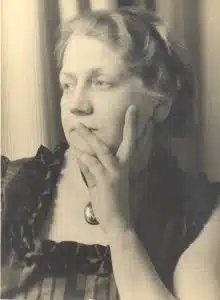
Olga Sacharoff (Tbilisi 1881- Barcelona 1967) studied Fine Arts, and soon moved to Paris, to the Montparnasse district, where she exhibited her work in the main avant-garde salons. Married to the painter and photographer Otho Lloyd, she established ties with the artistic circles of Paris at the beginning of the century. On the occasion of the two world wars, she stayed in Tossa de Mar, from where she promoted this destination as a meeting place for many avant-garde artists. She settled permanently in Barcelona in 1940 – in the Putxet district -, where she continued her artistic career and actively participated in the cultural life of the city.
Artistically, he used all kinds of techniques (oil, watercolor, pastel, collage or etching), and various genres and themes such as still lifes, landscapes, flower paintings, everyday scenes and portraits. He also illustrated literary works, such as Clementina Arderiu’s book Sempre i ara . His work has been exhibited, among other cities, in Paris, London and New York. In Barcelona, in 1953 a retrospective exhibition of his work was held; and later, in 1994, an anthological exhibition, curated by Maria Lluïsa Borràs and Mariette Llorens Artigas, at La Pedrera. Since then, no other individual exhibition of his career has been dedicated to him in Catalonia.
The Sacharoff Year, promoted by the Department of Culture, is curated by Elina Norandi and has the collaboration of the Barcelona City Council, the Art Museum Network, the University of Barcelona and the Llotja School of Design and Art.
Sacharoff Year aims to make known an artist who has not been sufficiently known or recognized in our country, who established strong ties with post-war artistic and intellectual circles, and who became a prominent figure in the artistic languages of the last century.