
From Blanes to Cap de Creus, identity of a landscape
The exhibition at the Girona Art Museum, subtitled From Blanes to Cap de Creus, identity of a landscape, is the result of more than three years of research and proposes an itinerary arranged geographically by the moments and places from which artists contributed, voluntarily or accidentally, to shaping and consolidating the “Costa Brava” brand. It presents around sixty paintings and documents by nearly 50 artists who, from 1870 to 1936, made the Costa Brava a subject of their work and, in some cases, the embodiment of an ideal.
The works come from numerous private collections and institutions in the country, such as the National Museum of Art of Catalonia, Museo Nacional Centro de Arte Reina Sofía, Madrid, Museo Sorolla, Madrid. Museo Carmen Thyssen Málaga, Museu de Montserrat or Royal Academy of Fine Arts of Sant Jordi. And there are also documents from the Library of Catalonia, Biblioteca Carles Fages de Climent and from the various archives of the various towns of the Costa Brava, such as the Blanes Archive, the Palafrugell Archive, the Tossa de Mar Archive, among others.
From the Costa Brava to the Costa Brava, in six exhibition areas
The exhibition, through 6 exhibition areas, traces the birth of the Costa Brava concept and highlights how artists nurtured it through their works.
The first deals with “The Costa Brava before the Costa Brava” with a rich selection of works by artists, landscape painters and plein air painters, who traveled the north coast seeking inspiration before it was named Costa Brava. Examples include the cartoonists Lluís Rigalt or Hedwige Alphonse Delamare, and the landscape painters Modest Urgell, Baldomer Galofre, Joan Roig i Soler, Jaume Vilallonga, Fèlix Mestres or Francesc Miralles. From this first area, a sketchbook, previously unpublished, by Ramon Martí Alsina stands out, which testifies to the artist’s stay in Sant Feliu de Guíxols in 1892, or the painting Costa amb penya-segats i mariscadors , from the Thyssen collection, a landscape of Cap de Creus, which has now been identified as the Rec de la Calç, in Cala Jóncols and which is direct evidence of Martí Alsina’s passage through Cap de Creus.
From the area of “An ideological baptism” stands out a letter and a postcard from Bonaventura Sabater addressed to Eugeni d’Ors, written in 1915 and 1916 respectively from the El Paradís estate, in Fornells, which points out this space as one of those closely linked to the Costa Brava.
The area “Painters on the Costa Brava. Identity Builders”, is dedicated to all those artists who contributed to the imaginary creation of the Costa Brava and its diffusion. On the one hand, it includes artists who consciously create their works along the lines of idealization of Hellenic roots and identification of the country with this part of the coast linked to the initial ideology of the Costa Brava, sister to the noucentista, such as, among others, Joan Llaverias, Joan Junceda, Nicolau Raurich, Joan Llimona or Joan Colom.
It also includes artists who, once they have produced their work, are identified by critics or writers as Costa Brava. This is the case of Joaquim Mir, Francesc Gimeno, Baldomer Gili Roig or Josep Mompou, among others.
An unpublished photograph of the surroundings of Mas Juny with Josep Maria Sert, Salvador Dalí, Gala and Dorothy Webster, wife of Nicholas Woevodski, among others, gives us what the Costa Brava was like in the thirties, a meeting point at a European level.
The two final areas are dedicated to two artistic foci of great relevance on the Costa Brava, Tossa de Mar and Cadaqués, Cap de Creus. A whole series of creators come to these two points of artistic confluence, completely outside this concept of country, in search purely of light and nature. This is the case of those who choose the path of the avant-garde such as Salvador Dalí, Picabia or André Masson who end up in these towns on the Costa Brava due to friendly relations between the painters themselves or because there were already channels for promoting the Costa Brava and hotels run by foreigners that facilitated communication routes through Europe, as is the case of Tossa de Mar.
The exhibition concludes with the area “Destruction of paradise. The first cries of alarm” dedicated to the pro-Costa Brava conference of 1935, from which the Costa Brava Board emerged, with the aim of protecting it and setting limits to its growth. But unfortunately the Civil War ruined all these good intentions. The words of Rafael Benet, written on the occasion of the Pro-Costa Brava conference, conclude the exhibition: “No big hotels. No overly compact plantations. The Costa Brava does not want noise. A little more hygiene: a little more politeness and that’s it”.
Two exhibitions and a catalogue
Costa Brava. The discovery of paradise 1870-1936, is a project, conceived and led by the Museu d’Art de Girona and shared with Museu de l’Empordà that is divided into two exhibitions, one in Girona and the other in Figures. The two exhibitions share a graphic image, museographic design and a single catalogue, the first of the exhibition trilogy, which will collect all the works from both exhibitions, the one at the Museu d’Art de Girona and the one at the Museu de l’Empordà in Figueres.
The catalogue incorporates texts by the curator and art historian, Mariona Seguranyes and the art historians Susanna Portell and Gloria Bosch, the latter dedicated to Tossa de Mar in the early 20th century, a pole of attraction for relevant European artists during the period between the world wars.
With the aim of expanding the information and experience of the exhibition, a free audio guide has been produced with which you can enter the world of both exhibitions, the one at the Girona Art Museum “From Blanes to Cap de Creus, identity of a landscape”, and the one exhibited at the Museu de l’Empordà in Figueres “When Cadaqués was a party”.
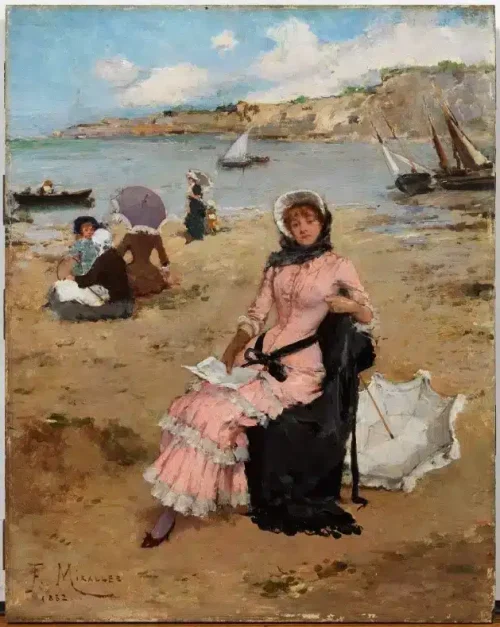
![Laureà Barrau (Barcelona, 1863 – Santa Eulària des Riu [Eivissa], 1957)
Tossa de Mar, 1908. Oli sobre tela. 78 x 100 cm. Museu d’Art de Girona, núm. reg. 138.820. Dipòsit del Fons d’Art de la Generalitat de Catalunya
Fotografia: Rafel Bosch](https://museuart.cat/wp-content/uploads/elementor/thumbs/portada-768x630-1-rjpwv1008gage28x5l5mxfks0s2tx2z37q4vuzfuv8.webp)