

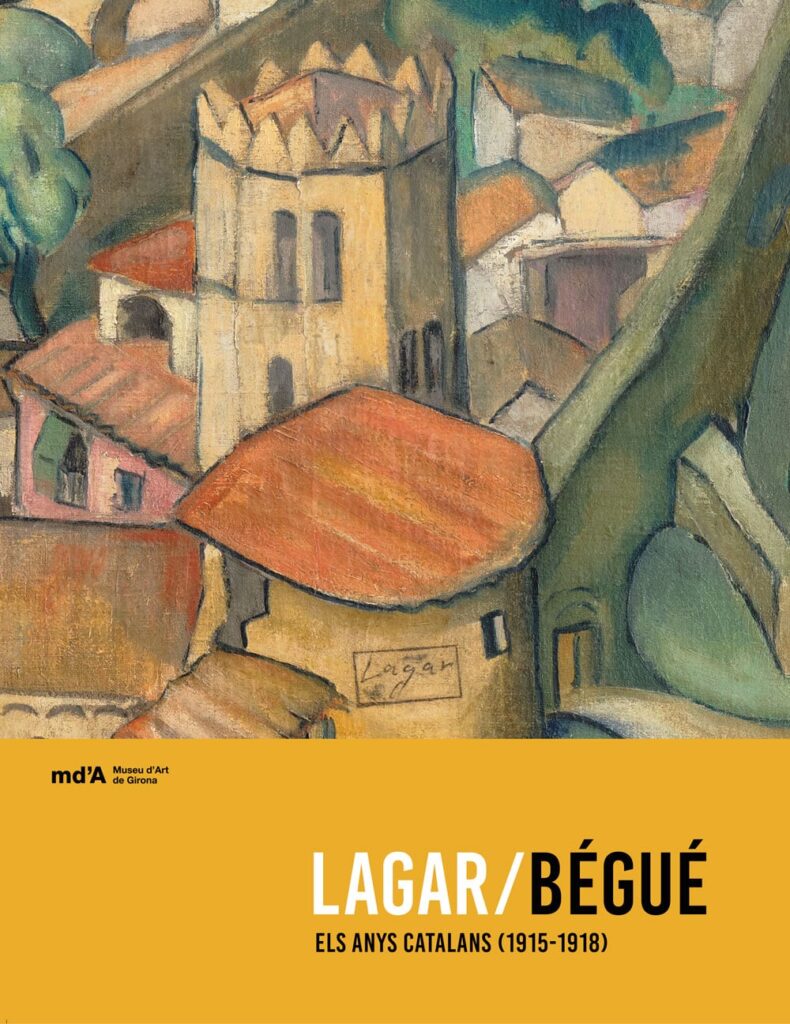
In 2018, the Department of Culture acquired at auction a work by Celso Lagar, El tren de França (1915), which was incorporated into the collection of the Museu d’Art de Girona. This oil on canvas, measuring 70 x 89 cm, depicts a view of the city of Girona with the tower and apse of Sant Pere de Galligants in the foreground, and with a train leading to France. The painting is one of five works that Lagar painted during a stay in Girona. Three years later, the exhibition “Celso Lagar and Hortense Bégué. The Catalan Years (1915-1918)”, curated by M. Lluïsa Faxedas, professor of art history at the University of Girona, has come to light. The exhibition reviews the work of the Salamanca artist between 1915 and 1918, coinciding with his stay in Catalonia. It also incorporates an area dedicated to his companion and sculptor Hortense Bégué, curated by María José González.
Celso Lagar (Ciudad Rodrigo, 1891 – Seville, 1966) arrived in Paris in 1911, thanks to a scholarship from the City Council of Ciudad Rodrigo. There he met Hortense Bégué (Cauvós, 1890 – Paris, 1957), who had moved there in 1909 to train in sculpture. Both artists arrived in Barcelona towards the end of 1914, fleeing the First World War. Throughout the Catalan Triennium, they made complementary stays in Paris, Madrid, Bilbao and Galicia, and held different exhibitions in Barcelona, Girona, Madrid and Bilbao. They published drawings in Catalan cultural magazines and strengthened ties with figures of the Catalan avant-garde such as Salvat-Papasseit, Junoy, Barradas and Torres-García. In Catalonia, Lagar developed planism.
The catalogue accompanying the exhibition comprises a total of six articles written by specialists in Lagar and Bégué. This section opens with an article by Faxedas, which reviews Lagar’s years in Catalonia. It is followed by an article by González, which rescues the figure of Bégué and his animalistic work from oblivion. There are also studies by Iván García, who makes a historiographical selection focused on the milestones achieved by Lagar between 1910 and 1920; Eva Vàzquez, who traces Girona in 1915, where the couple lived for six weeks; Begoña Farré, who delves into the concept of primitivism in Catalan art in the 1910s; and Isabel García, who contextualises Lagar in the early days of the Spanish avant-garde. The catalogue includes the hundred works and documentary materials that can be seen in the exhibition; a set of forty cards provide second readings of the works exhibited. All texts are in Catalan, with translations into Spanish and English. A careful bibliographical selection concludes the catalogue.
Cristina Ribot Bayé
Catalog coordinator
The catalogue can be purchased at the Museu d’Art shop and also online at the Generalitat de Catalunya bookstore.