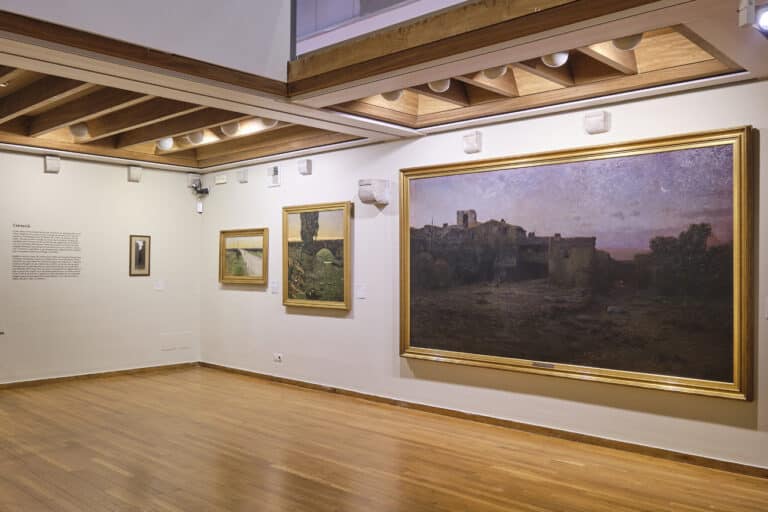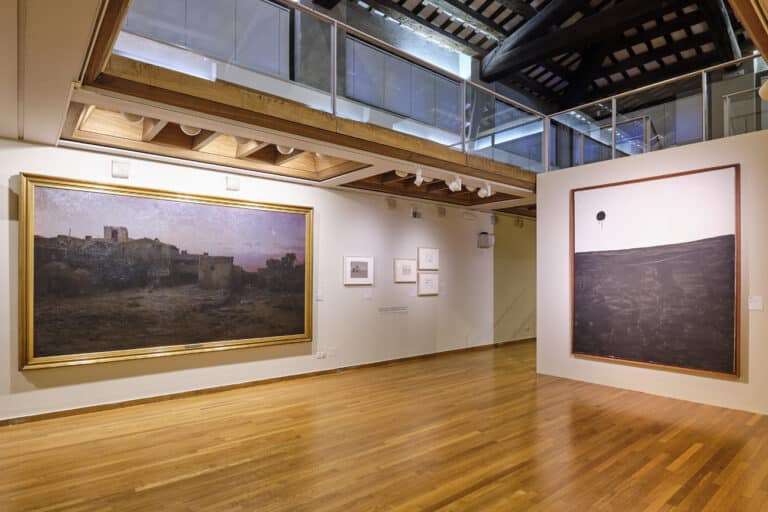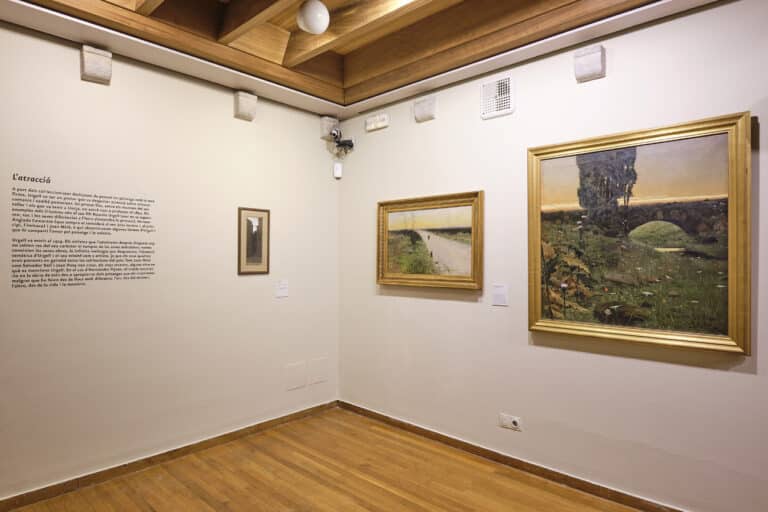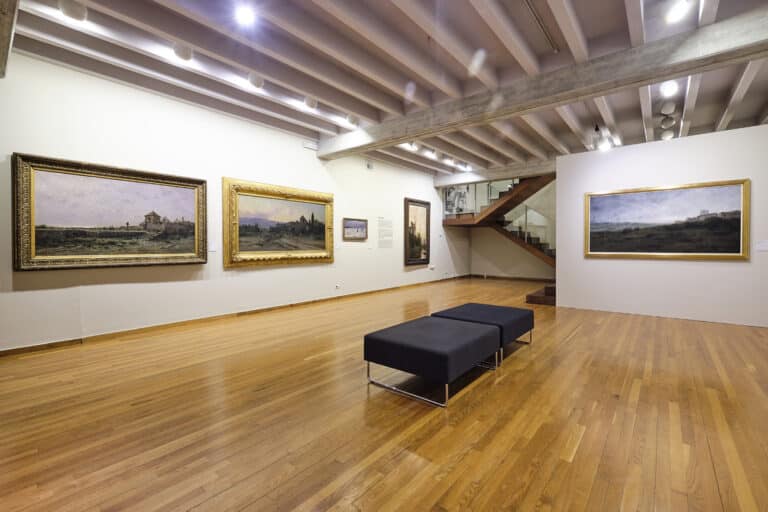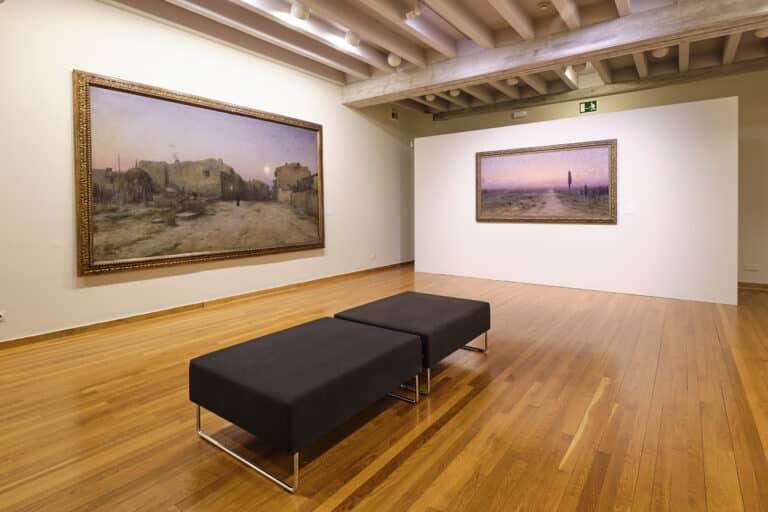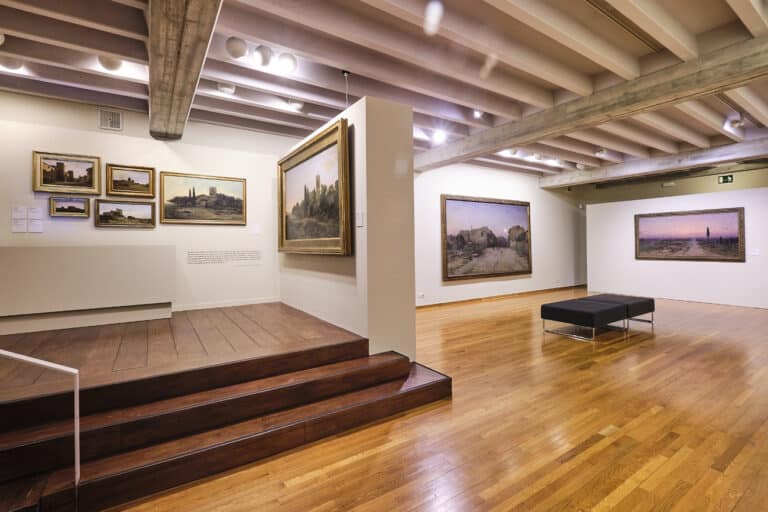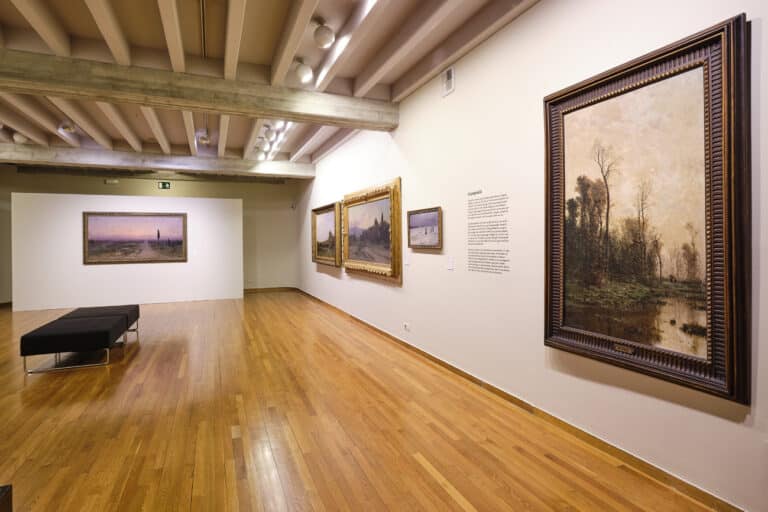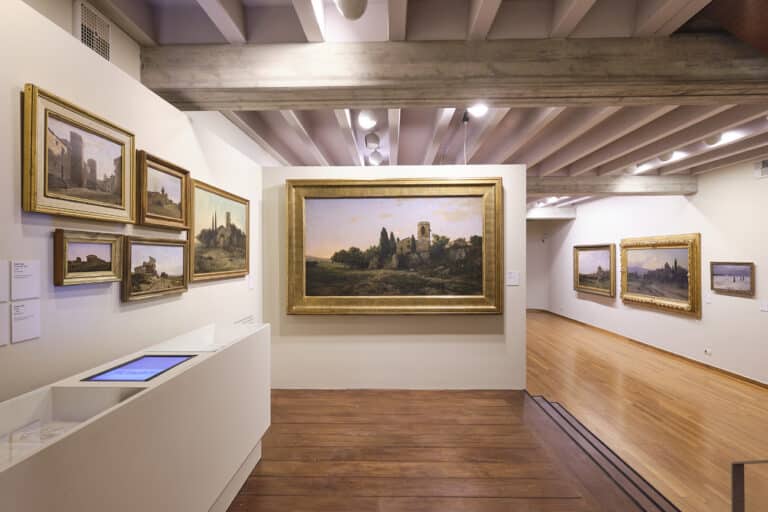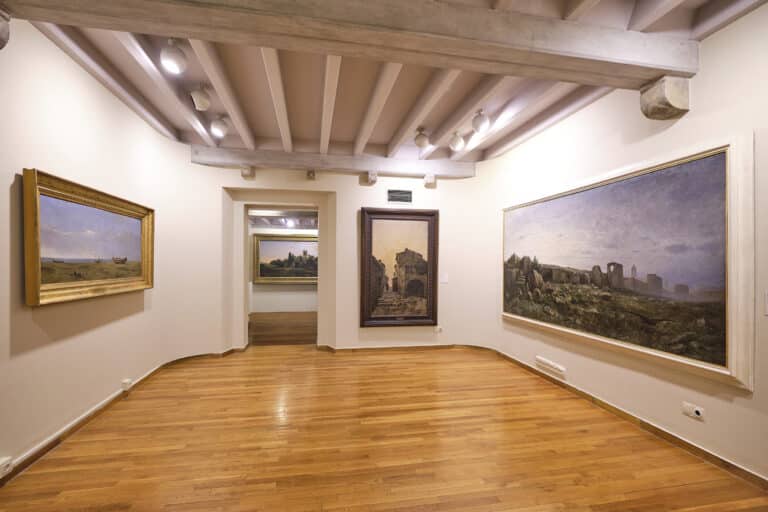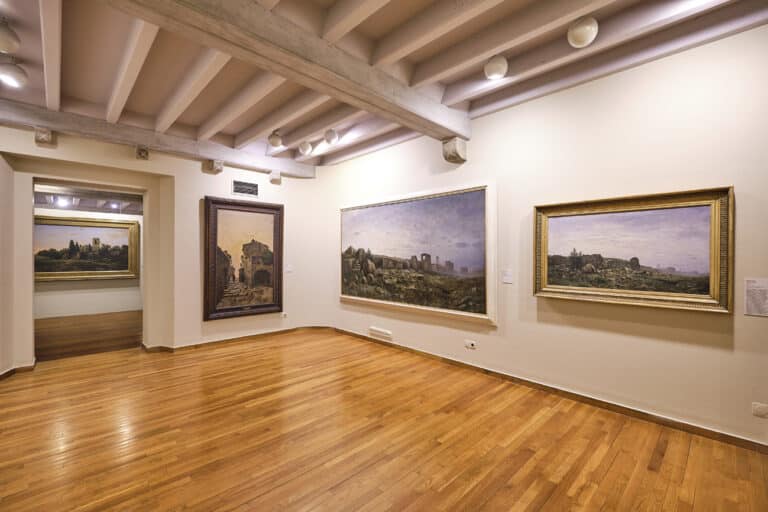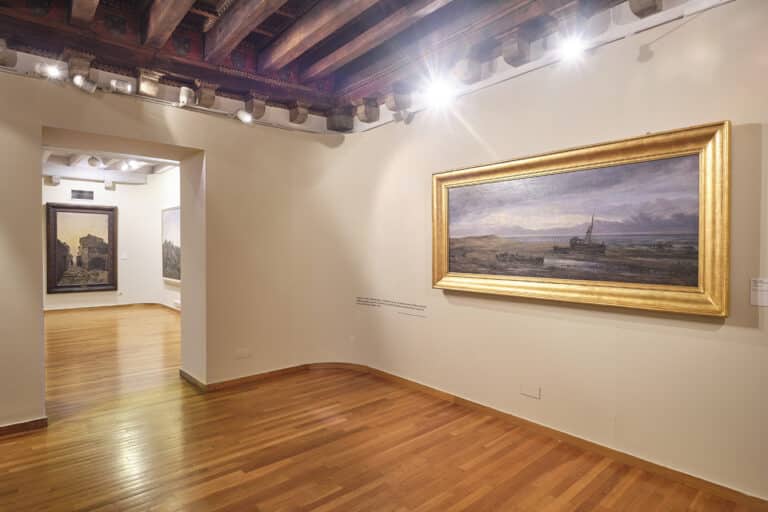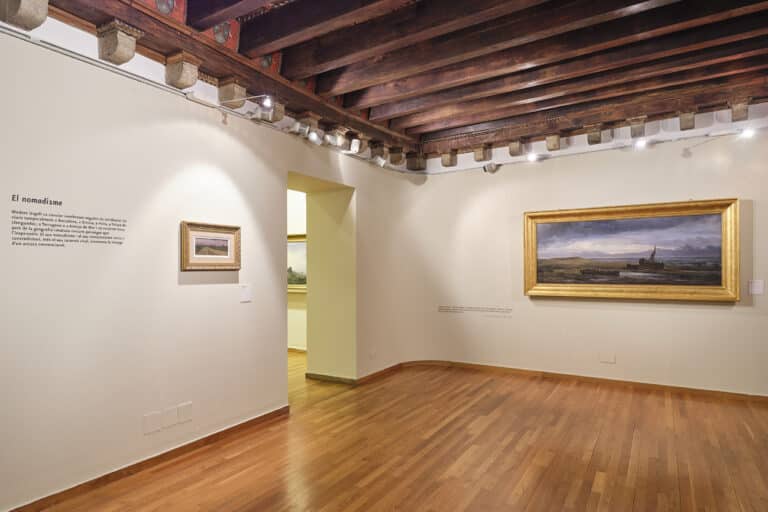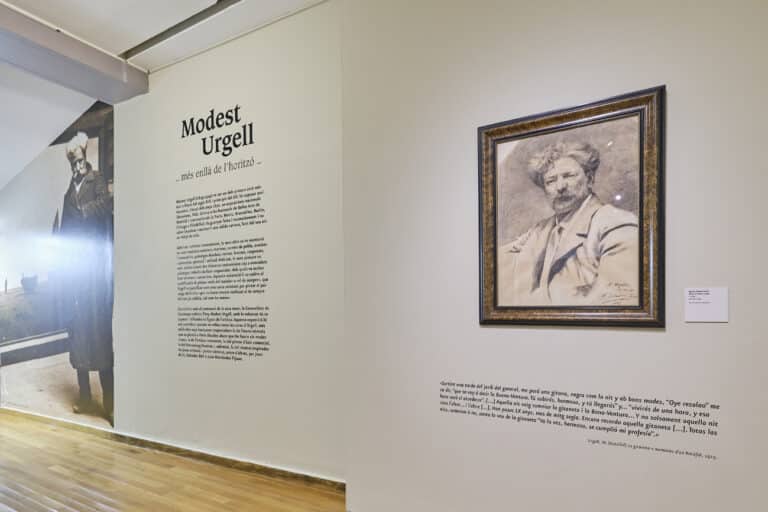

Modest Urgell (1839-1919) was one of the most successful painters of the late 19th and early 20th centuries. He exhibited regularly, from the 1870s, in national exhibitions (Barcelona, Olot, Girona or the National Fine Arts Exhibitions in Madrid) and international exhibitions (in Paris, Munich, Brussels, Berlin, Chicago or Philadelphia). He gained fame and recognition and was able to promote and maintain a solid career, making his art a means of living.
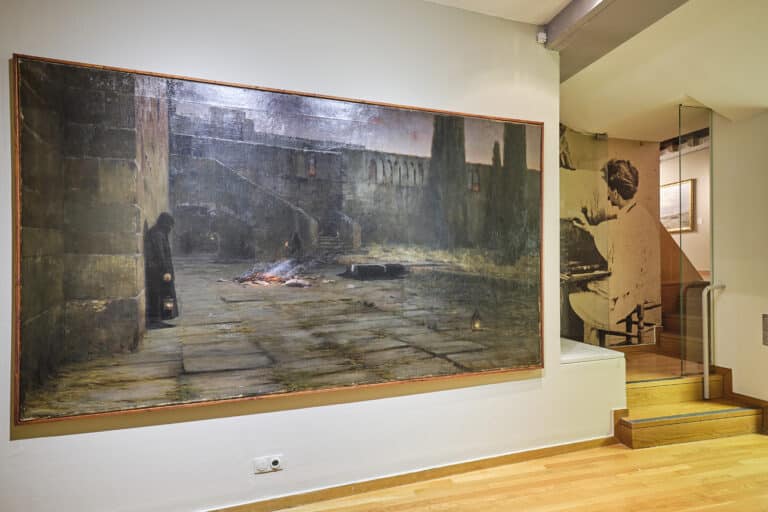
Intensely admired and criticized, his work remained on a constant theme: seascapes, village streets, hermitages and cemeteries, desolate landscapes, ruins, witches, bats, sunsets, stillness and solitude. However, his painting evolved from costumbrist scenes towards evocative landscapes imbued with twilight light, of which he ended up making versions and variations.
This reiteration earned him the qualification of painting “more of the same” or “the usual”, which Urgell justified as a constant search to paint the definitive landscape: “for not having yet done the usual as I would like, as I dream of it”.
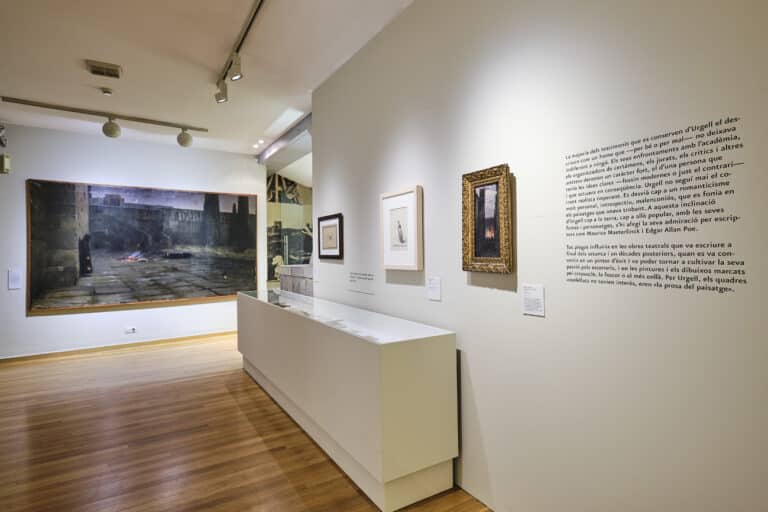
Coinciding with the centenary of his death, the Generalitat de Catalunya is celebrating the Modest Urgell Year, with the aim of recovering and disseminating the figure of the artist. This exhibition aims to contribute by highlighting all the faces of Urgell, beyond its twilight horizons: that of the eternal nomad who settled in Paris decades before the modernists did, that of the irreverent artist, that of the commercially successful painter, that of the frustrated playwright and, above all, that of the inspiring master of young artists and painter admired, among others, by Joan Miró, Salvador Dalí or Joan Hernández Pijuan.
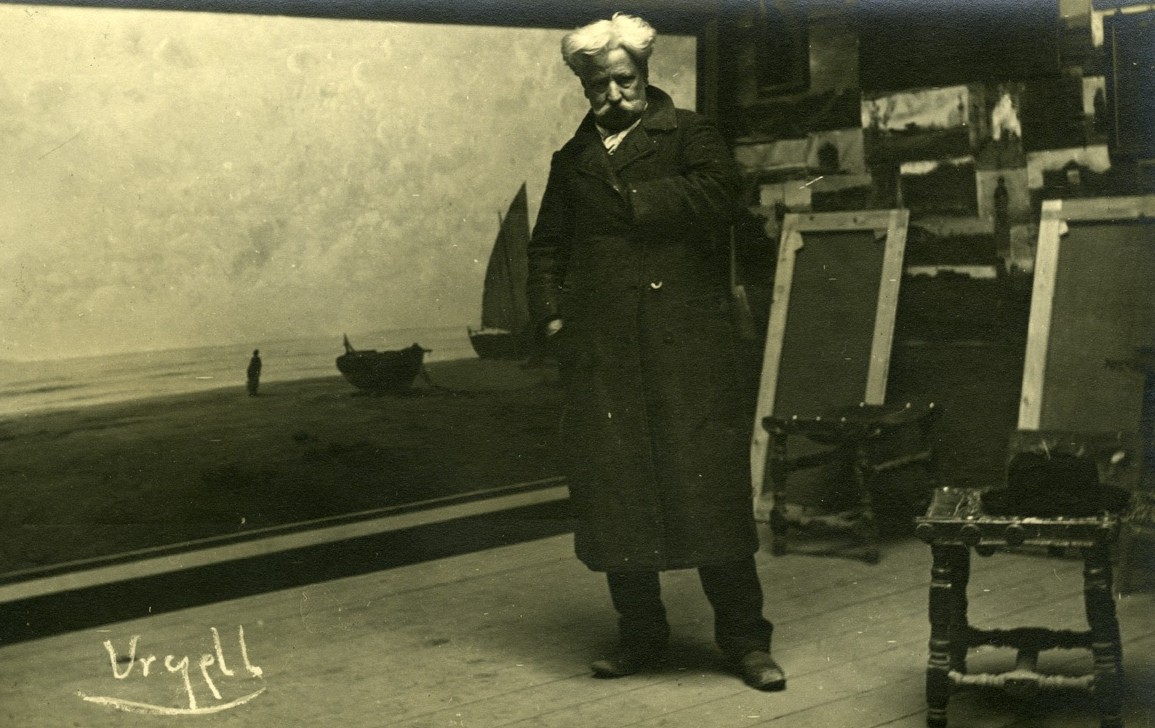
Francesc Serra, Modest Urgell, right in his workshop (detail) (1903). Barcelona Photographic Archive
Modest Urgell was born in Barcelona on June 13, 1839, fifteen years before the city walls began to be demolished. Coming from a wealthy family, he soon showed a strong inclination towards the arts, especially theatre and painting, to which he eventually devoted himself.
He studied at the Escola de Llotja in Barcelona and, under the tutelage of the painter Ramon Martí Alsina, he began painting in a realistic style. He married the painter Eleonor Carreras Torrescasana (1843-1907), with whom he shared his profession and exhibitions during the first years of their marriage, and of whom very little is known and no work has survived. They had a son, Ricardo Urgell (1873-1924), who would also end up dedicating himself to painting with notable success, although with a very different theme from that of his father, and a daughter, Modesta, who is known to have exhibited as well —along with her father and brother— in Barcelona in 1896.
«Leaving the general’s garden one afternoon, a gypsy stopped me, black as night and with good manners , “Hey, pray,” she said to me., “que voy á decir la Buena-Ventura. You will go up, beautiful, and you will arrive” and… “you will live for one hour, and that hour will be sunset”. […] That night I dreamed of the gypsy girl and Bona-Ventura… And not only that night but the next… and the next […]. Sixty years have passed, more than half a century. I still remember that gypsy girl […]. Every night, whether I dream or not, I hear the gypsy girl’s voice “You see, beautiful, my prophecy has been fulfilled.”
Urgell, M. [Katúful] The Gypsy Girl or Memoirs of a Katúful, 1918.
The current Ciutat Vella district of Barcelona was the place where Modest Urgell grew up and where he had his first contacts with art and theatre, his other great passion. Years later, in 1908, Urgell participated in the drawing competition organised by the Barcelona City Council on the opening of Via Laietana, and was the winner in the category of “coloured drawings”.
In 1894, Urgell joined Llotja as a professor of Landscape, and in 1895 he obtained the position. Years earlier, after living in various places, he had returned definitively to Barcelona, where he set up his workshop at number 22 of Carrer de Padilla —currently Aulèstia i Pijoan—, in the village of Gràcia and very close to Plaça de Lesseps. He shared it with his son Ricardo, who was also a painter, but with a completely different style and subject matter (he focused mainly on the world of entertainment). From this workshop, in the summer of 1909, Modest Urgell saw and experienced the events of the Tragic Week, which made a strong impression on him. Some time later he would dedicate a short story, accompanied by drawings, to the events of those tumultuous days.
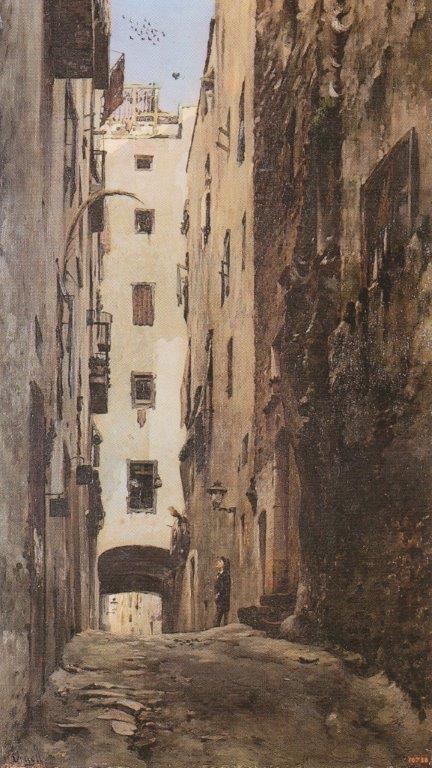
Modest Urgell. Carrer de Fivaller (Barcelona) 1873. Oil on canvas. 74 x 43 cm. Contribution of the Barcelona Provincial Council, 1906. MNAC 010738. National Museum of Art of Catalonia, Barcelona
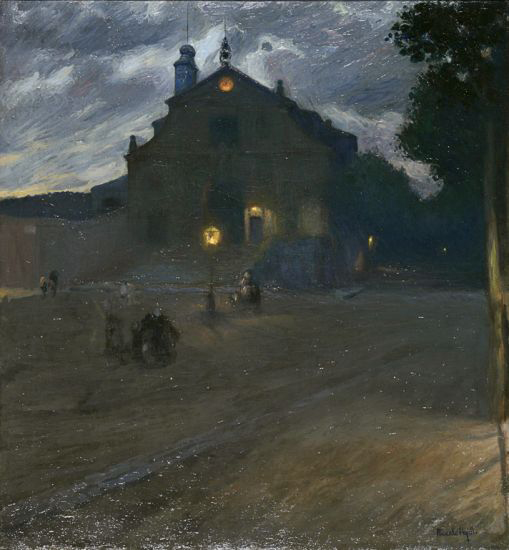
Ricardo Urgell, Plaça de Lesseps at night (church of Josepets) 1908. Oil on canvas. 95 x 88 cm. Collection Miquel Codes and Antonia Luna
“Last of July 1909. […] Plaza Lesseps and calle Mayor presented a sinister aspect. Closed shops and portals, broken lampposts, barricades at the mouths […] Shortly before midnight on the 29th, vague and distant rumors were heard from the “Josepets” in Gracia, then shouts, threats, profanities, voices of fire, discharges, lamentations and curses, then… nothing.
Urgell, M. (1913) The bat Memoirs of a patum , Barcelona: L’Avenç
Modest Urgell’s beginnings were not easy. His work was not well received by the academy and he had difficulty making his way in the Catalan capital. Having just married Eleonor Carreras, the couple moved to live in Girona, the city where, years later, he would declare having spent the most peaceful years of his life, despite economic hardship. Neither the year of arrival nor the year of departure are clear, but it was a long stay, between the 1860s and 1870s.
In Girona, under the pseudonym Katúful, Urgell dedicated himself to drawing seagulls on commission, giving drawing classes and touring and painting the surrounding villages. Then came his first recognition, in 1864, with a special honorable mention at the Exposición Nacional de Bellas Artes in Madrid for the work Costes de Catalunya . And, then, the trips to Paris, which would end up being decisive in his career.
“The most peaceful years of my life are, perhaps, those I spent in Girona, on that third floor of Carrer de la Forsa; with my head full of illusions and without a penny in my pocket. I still think I see that room, where I would lock myself up from sun to sun to paint, write, smoke, rest for a while and dream at all hours, especially towards evening, when the sun, setting behind the dry trees of La Devesa, left the distant mountains in half light.”
Urgell, M. «The Panel», Joventut (January 2, 1902)
Modest Urgel, Coasts of Catalonia (1864). Oil on canvas · 75 x 159 cm. Girona Art Museum. Reg. no. 251.760. Prado National Museum deposit
With this work, Modest Urgell won an honorable mention at the 1864 National Exhibition of Fine Arts in Madrid, the first of the seventy exhibitions in which he is known to have participated. The award marked the beginning of a change of direction in the artist’s recognition. The work, now owned by the Museo Nacional del Prado, was acquired by the State in February 1865 and deposited in the Museu de Girona in 1876.
Modest Urgell changed his residence many times. He lived temporarily in Barcelona, Girona, Paris, Toulouse, Tarragona and Arenys de Mar and travelled a good part of the Catalan geography looking for landscapes that would inspire him. His nomadism and his isolated and contradictory romanticism, plus his vital temperament, broke the image of a conventional artist.
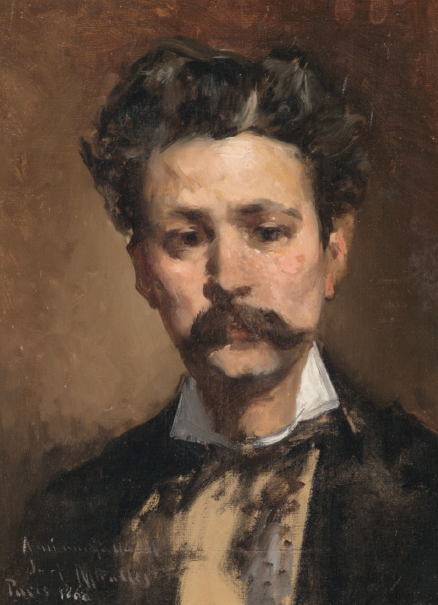
Francisco Miralles, Portrait of the painter Modest Urgell (1868). Oil on canvas. 48 x 38 cm. Jordi Ruiz Sanchis Collection
Although there are still many gaps in Urgell’s biography, it is known for certain that he made several trips to France. It is known that in 1862 he was among the foreign students accepted at the École Impériale Spéciale de Dessin et de Mathématiques in Paris; that in 1867 he presented a winter landscape at the French Universal Exhibition; that the following year Francisco Miralles portrayed him in his Parisian studio; that in 1872 he exhibited at the Salon held at the Palais des Champs-Élysées, and that in 1878 —when the railway connection with France was inaugurated in Catalonia— he returned to the French capital as one of the artists selected to participate in the Spanish pavilion at the Universal Exhibition. Once there —according to him— he would deal with figures such as the painter Camille Corot, the actress Sarah Bernhardt and the writer Alexandre Dumas (son). There he was also able to see the landscapes of Charles-François Daubigny, possibly the artist most akin to his sensibility.
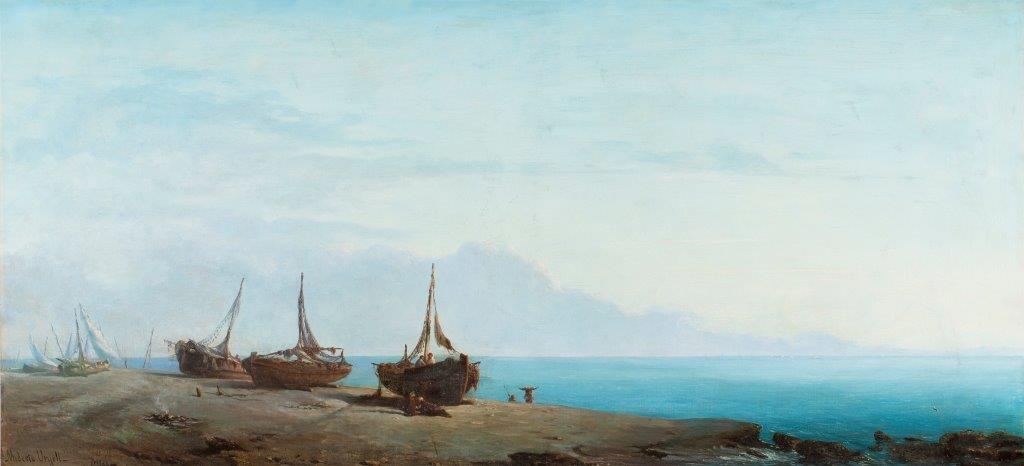
In addition to Paris, Urgell was one of the first artists to go and paint the seaside town of Berck, which, located near the Pas de Calais, would end up becoming a place of pilgrimage for numerous painters, such as Édouard Manet, Eugène Boudin or Ludovic-Napoléon Lepic, le Patron (the friend of Degas considered the driving force behind this pleiad of painters who invaded the town). Urgell would do so before all of them, throughout the months of a summer that would be decisive in the development of his painting, marked by landscapes with low horizons and skies full of subtle atmospheres.
“Berk: the closest beaches to Paris and the most important tide in France. […] Aristocratic ladies and Parisian Sirens come there during the summer […]. I left on the first of June; I spent three months painting on those beaches and sleeping in a fisherman’s hut licked by the sea when the tide rose. In the evening he received visits from Parisian bathers who bought notes and sketches painted during the day at a good price. On the third of September he returned to Paris with two sailors for Gupil and six thousand francs.
Urgell, M. (1913) The bat Memoirs of a patum , Barcelona: L’Avenç
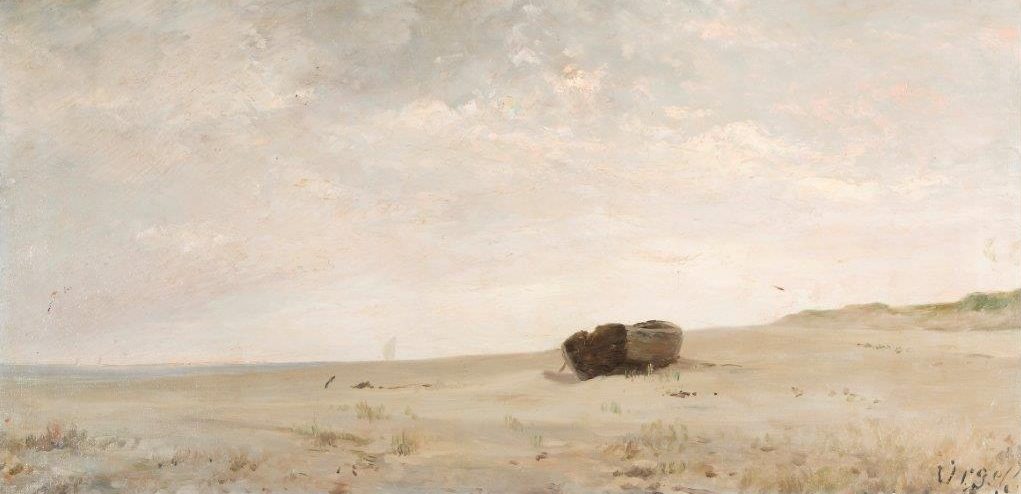
Modest Urgell, Marina (Berck) (before 1873). Oil on canvas · 38 x 77 cm. Girona Art Museum. No. reg. MDG 250.360. Girona Provincial Council Art Fund
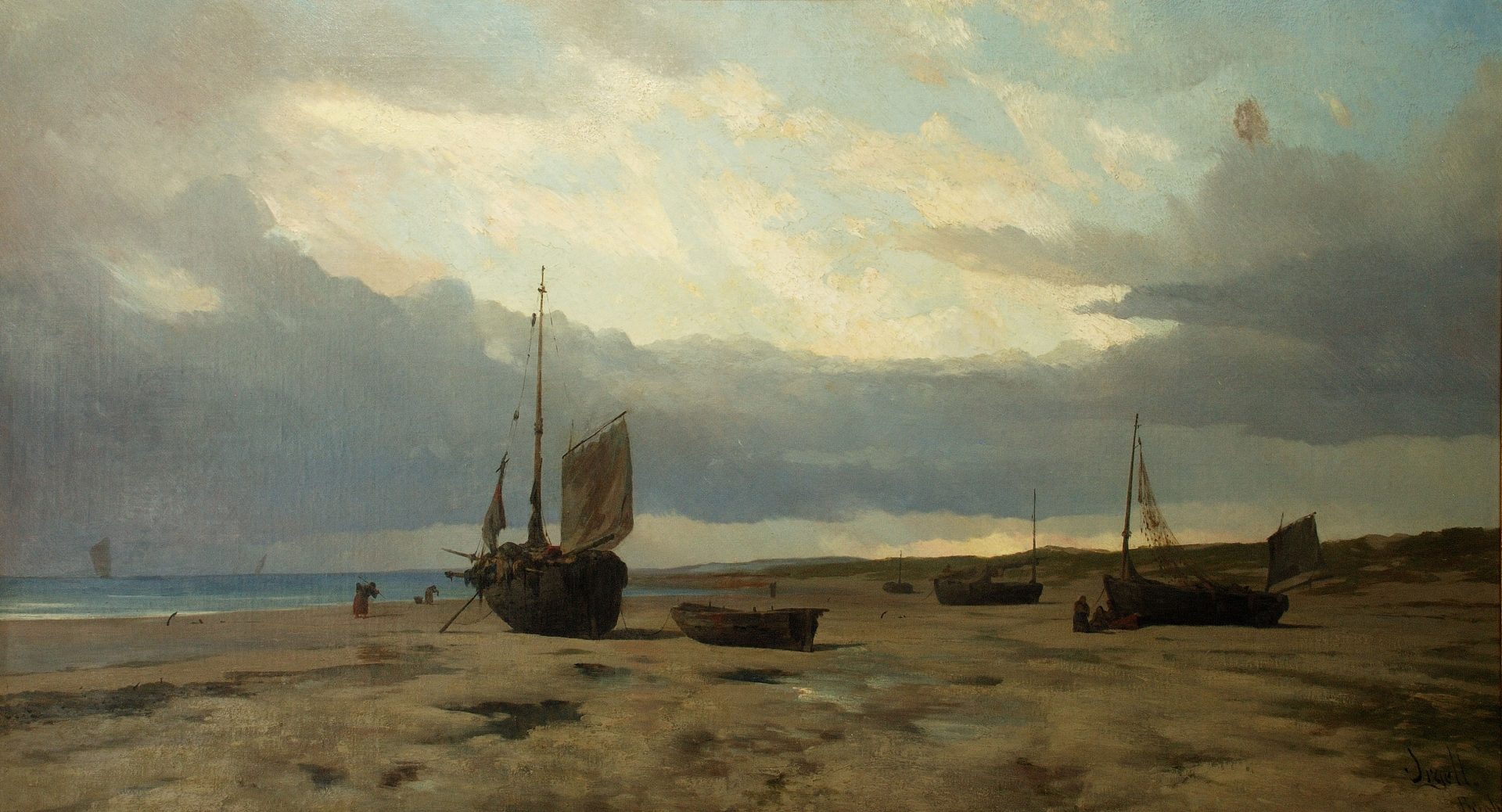
Modest Urgell, Boats on the Beach (Berck) (c. 1868-1872). Oil on canvas · 100 x 181 cm · CTB. 2015.33 Carmen Thyssen-Bornemisza Collection, Madrid
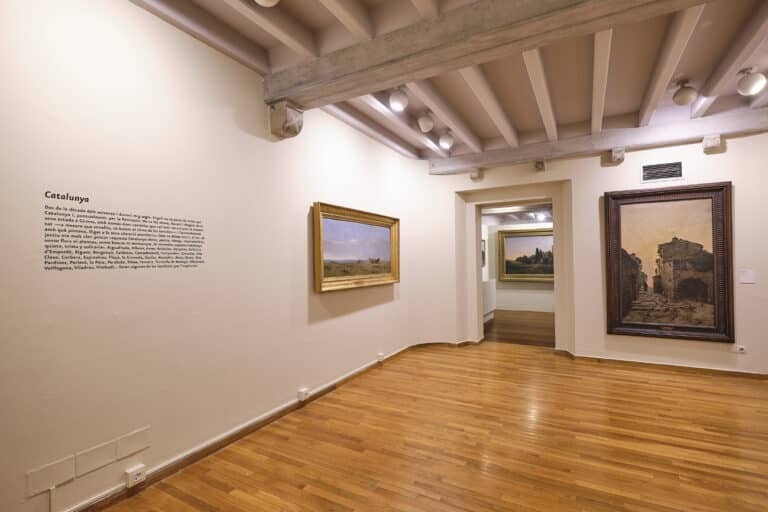
Since the 1960s and for half a century, Urgell has been constantly touring Catalonia and, occasionally, the Peninsula. He did this before, during and after his stay in Girona, with only two variables to take into account: the intensity —as he grew older, the pace of his outings decreased— and the accommodation with which he painted, linked to his economic situation.
As he wrote, his goal was very clear: to paint “this Catalonia of mine, small, desolate, dismantled, without flowers or plants, without forests or mountains or orchards; this quiet, sad and lonely Catalonia”. Aiguafreda, Albons, Amer, Arbúcies, Banyoles, Bellcaire d’Empordà, Bigues, Borgonyà, Caldetes, Campdevànol, Camprodon, Centelles, Cinc Claus, Corbera, Espinelves, Flaçà, la Granada, Gualta, Hostalric, Mata, Ocata, Olot, Pardines, Parlavà, la Pera, Peralada, Ribes, Tamarit, Torroella de Montgrí, Ultramort, Vallfogona, Viladrau, Vimbodí… were some of the places that inspired him.
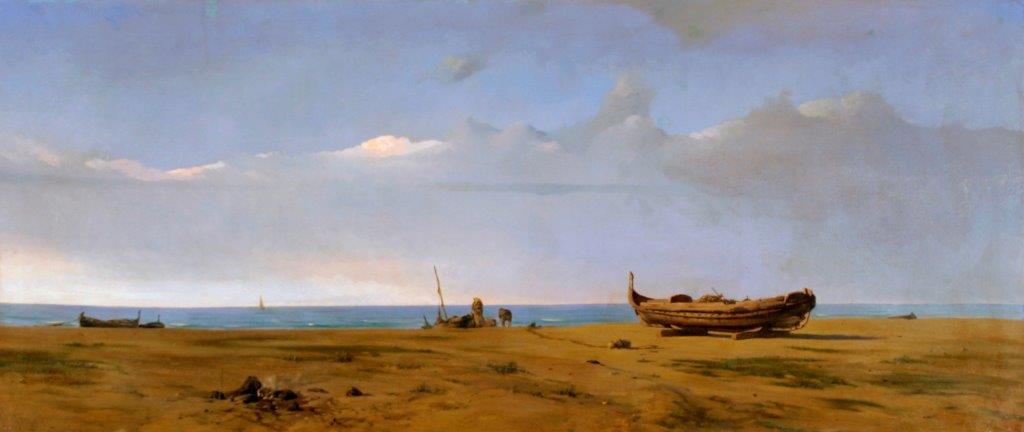
Modest Urgell, Platja de l’Arrabassada (1873) (before). Oil on canvas 58.7 x 148 cm. Girona Art Museum. No., reg. 251.761. Girona Provincial Council Art Fund
“This Catalonia of mine, small, desolate, dismantled, without flowers or plants, without forests or mountains or gardens; this quiet, sad and lonely Catalonia, dominating that horizontal line, which I have been criticized so much for, that fence and that cypress tree, those poorly paved alleys and the abandoned boat… And so on for 45 years!”
Urgell , M. (1905) Catalonia , Barcelona: Miquel Seguí ed.
During the 19th century and part of the 20th, Girona was closely linked to a myth: that of the city’s heroic resistance in the sieges of 1808 and 1809, in the context of the French War, the origin of a whole literature that simplified the events that had a parallel in painting, with action-packed paintings such as those created by Ramon Martí Alsina ( El gran dia de Girona , 1863-1864, headquarters of the Generalitat de Catalunya, Girona) and César Álvarez Dumont ( El gran dia de Gerona , c. 1890, Museo Nacional del Prado, Madrid). Urgell also touched on the subject, but —in another example of how he went for free— he opted for an allegorical composition in which only the walls and an eagle appeared in the foreground, thus disregarding the spectacularity of the battle. In fact, he painted two versions of this subject: the one currently preserved in the Girona Art Museum, dated to the 1970s, and the one that King Alfonso XII kept, of much larger dimensions and which Urgell created around 1881, at the peak of his career and when he no longer lived in Girona.
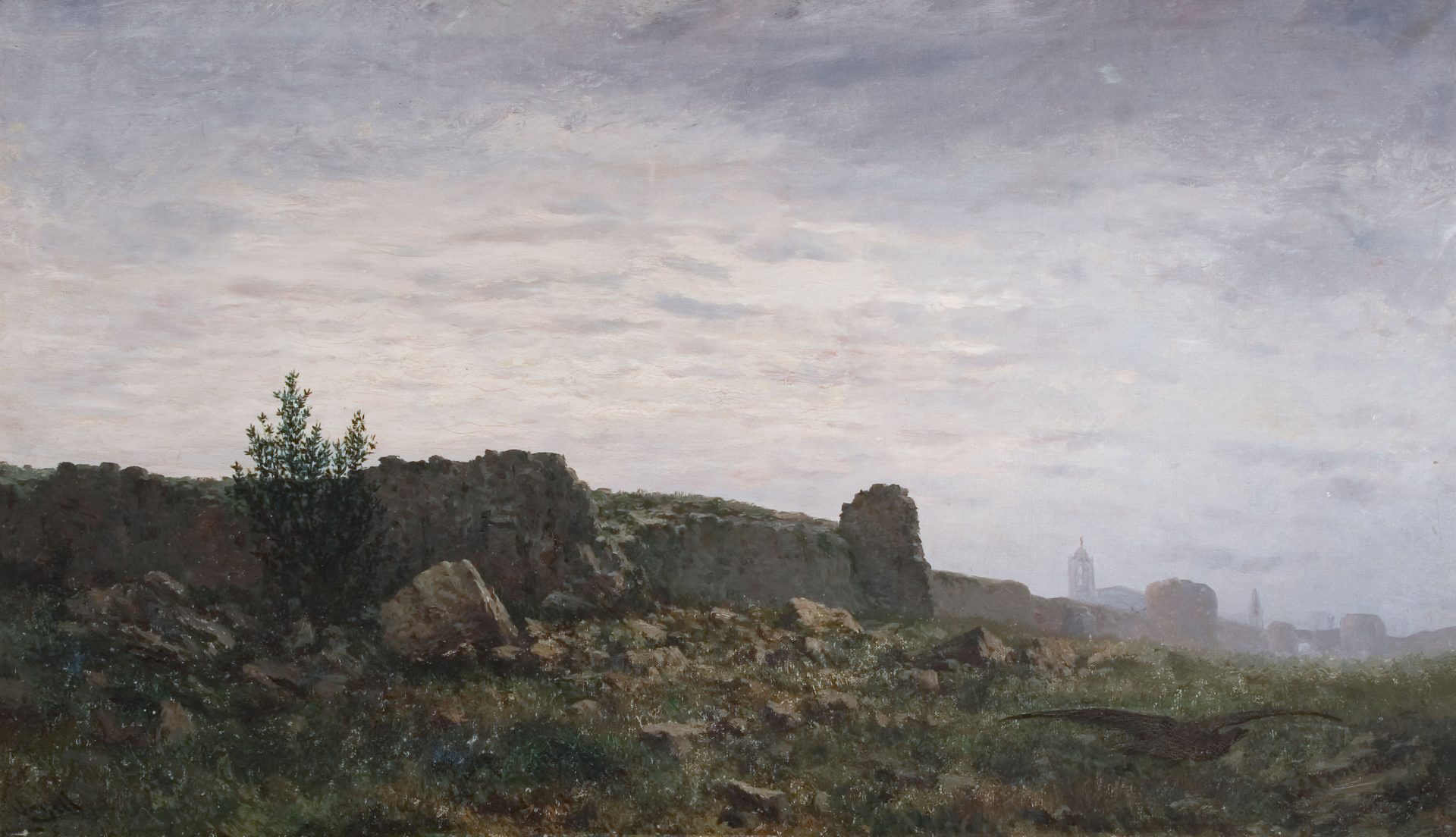
Modest Urgell, Walls of Girona (c. 1871) · Oil on canvas · 67.7 x 116.5 cm. Girona Art Museum. Reg. no. 250.295. Girona Provincial Council Art Fund
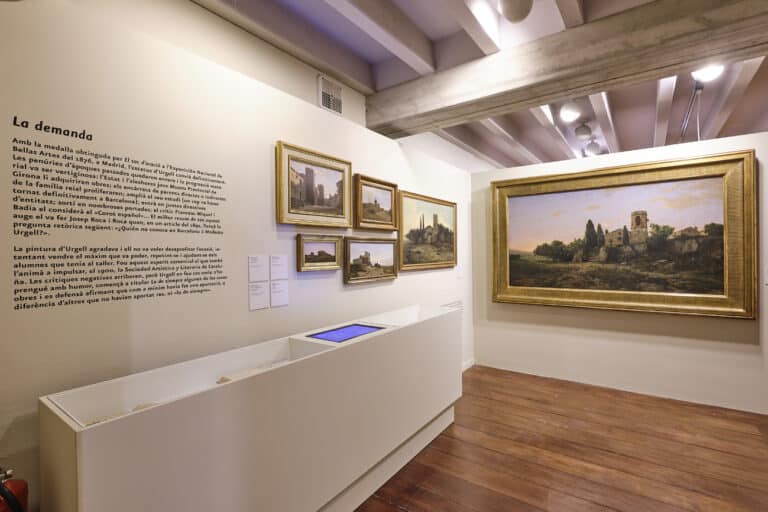
With the medal obtained for The Prayer Tap at the 1876 National Exhibition of Fine Arts in Madrid, Urgell’s status changed definitively. The hardships of past times were left behind and material progress was dizzying: the State and the then young Provincial Museum of Girona acquired works from him; commissions from direct or indirect relatives of the royal family proliferated; he expanded his studio (once he had definitively returned to Barcelona); he joined the boards of directors of entities; he appeared on numerous covers; the critic Francesc Miquel i Badia considered him the “Spanish Corot”… The best summary of all this boom was given by Josep Roca i Roca when, in an article from 1891, he posed the following rhetorical question: “¿Quién no conoce en Barcelona á Modesto Urgell?”.
Urgell’s painting was popular and he did not want to miss the opportunity, trying to sell as much as he could, repeating himself and getting help from the students he had in the workshop. It was this commercial spirit that also encouraged him to promote, in 1900, the Sociedad Artística y Literaria de Cataluña. The negative criticisms arrived, but Urgell ignored them: he took it with humor, began to title some of his works Lo de siempre and defended himself by stating that at least he had made a contribution, unlike others who had contributed nothing, not “lo de siempre”.
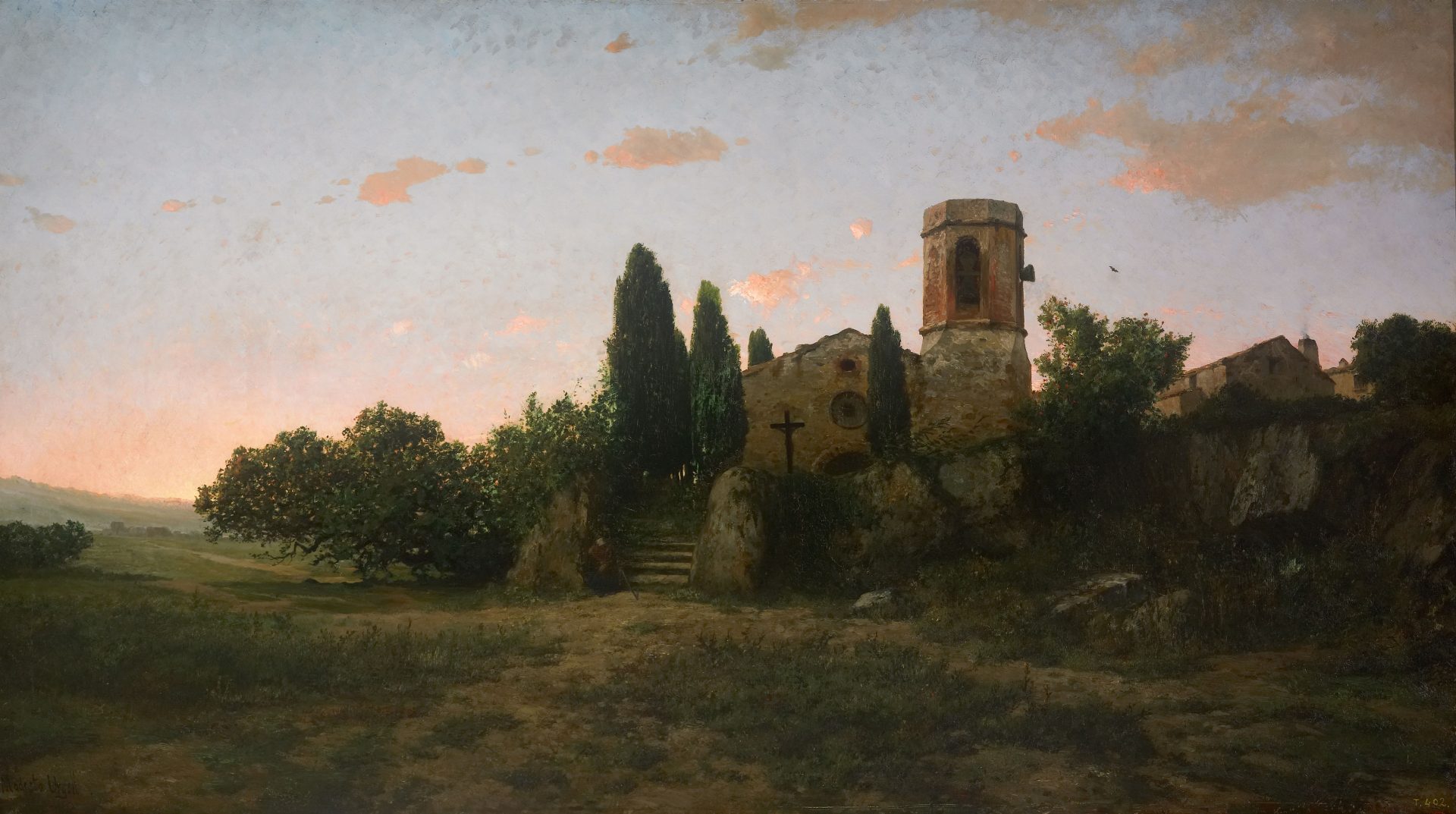
«A long time ago, during a summer afternoon and looking for impressions in the surroundings of Gelida, I was surprised by the silhouette of a church with its bell tower and a cypress, standing out against a sunset sky, sad and melancholic; the stillness interrupted by the tolling of the bell, in that solitary place, invited meditation; only a bat gave signs of life fluttering around me […]. Three months later, a painting, The Toque de la Oración, caused a great stir in Madrid: the public, critics and juries, praised it, it was acquired by the State and reproduced by painters from home and abroad.»
Urgell , M. (1905) Catalonia , Barcelona: Miquel Seguí ed.
The adjective romantic is fully justified in Urgell, especially because he felt it. But he was a contradictory romantic who always sailed alone: first, because when he achieved his style there was no one who did the same (he only had some occasional retorts in his friend Joaquim Vayreda or in the young Rusiñol) and, secondly, because the world continued to change and he did not want to know anything about it.
Urgell put emotion before identification, and he did so in such a discreet way that it can only reach the viewer by way of intuition. The definitive Urgell does not put characters who express the emotion he intends to share, but paints a landscape and adds a laconic “that’s how I felt it”. Urgell’s romantic sublime has the meaning of unlimited, of going beyond the horizon, but never of something that overflows.
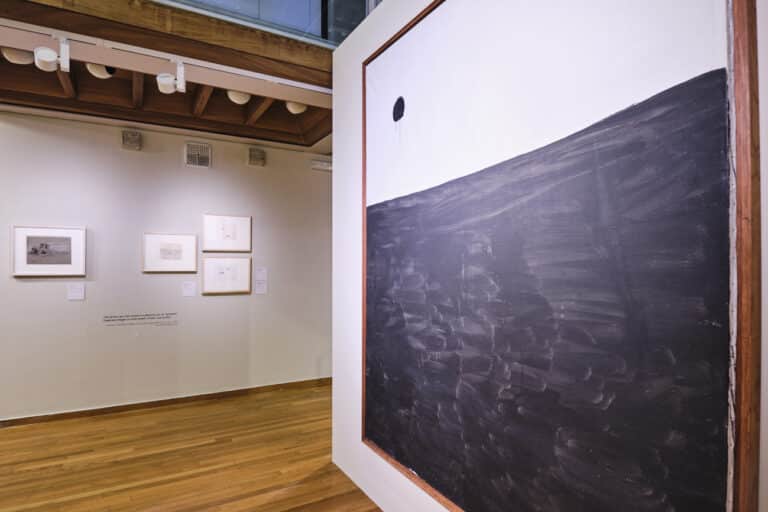
If being silent is the way to be oneself or the closest to it, the simplest, emptiest, most silent landscape should be the one that allows the painter to “listen” best. Urgell emptied and simplified the landscapes he systematically appropriated, but as a man born in 1839, he had some limits in this process. It would be the artists of later generations, such as his student Joan Miró, who would break all the barriers.

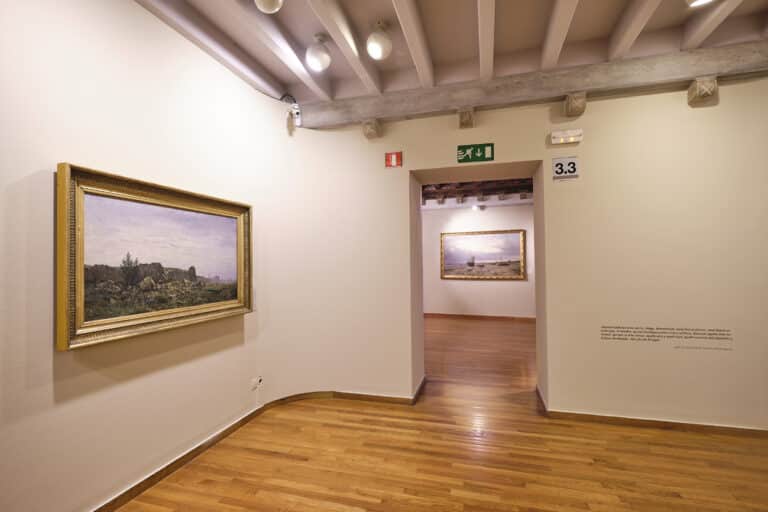
Modest Urgell, El Pedregal (c. 1895). Oil on canvas · 155 x 300 cm. Ricardo Urgell Martí Collection
“ I don’t take photographs, nor portraits, nor copy nature; I interpret suggested by the first impression, y
for this, earth, sea, sky, fields and stony places, beaches and marinas, cypress trees, towns and alleys and geese and scoundrels,
they are and will always be, in the eyes of the public, “the de siempre”. »Urgell, M. (1905) Catalonia, Barcelona: Miquel Seguí ed.
The Year of Urgell, declared on the occasion of the centenary of the death of the artist Modest Urgell i Inglada (Barcelona, 1839 – 1919), aims to commemorate one of the most recognized painters in our country but, paradoxically, also one of the least studied in depth. At the same time, it wants to recover and disseminate the figure of the artist, bring to light the most unknown passages of his life and work and, above all, awaken interest in his discovery and, hopefully, research and study.
So far, apart from the exhibition at the Girona Art Museum that is now being presented, other initiatives have been promoted by the Víctor Balaguer Museum in Vilanova i la Geltrú, the Badalona Museum and soon also the Solsona Museum, which have presented the works of Urgell that they preserve in their collection.