

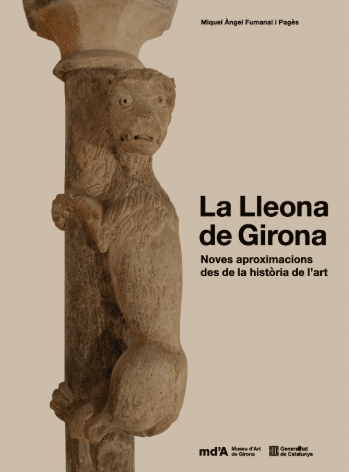
The Girona Art Museum has launched a monographic study and the most complete to date on the iconic sculpture of the Girona Lioness, the column with the sculpture of a lion clawed at the top of the shaft, known as “the Lioness” of Girona. This is the first monographic work dedicated to the study of this sculpture, curated by the art historian Miquel Àngel Fumanal. The edition, with just over 60 pages, proposes the most exhaustive review of all the information known to date about the column, in addition to obtaining unpublished data and an analytical description of the piece. In addition, it allows the piece to be placed within an artistic context, and it has been possible to specify its chronology, material nature or the vicissitudes it has experienced since the 19th century. Few people know that the column with the sculpture of a lion clinging to the top that is at the foot of the stairs of the church of Sant Feliu de Girona, and which has become famous for the tradition of kissing its ass to return to the city, dates from 1995, and that it is a second copy that replaced a first copy from 1985. The original sculpture is in the Girona Art Museum. It is carved in nummulitic limestone from Girona and measures, including the column, 366 x 46 x 38 cm, is broken into 9 fragments and has remains of 19th century polychrome. It was precisely during the 19th century, as the publication reveals, that a certain ambiguity was created regarding her identification, as she was often described as a monkey, and later as a lioness. However, this argument did not gain weight, since the lion was a common animal in the iconographic and symbolic repertoire of the Middle Ages in Europe.
Formally, the figure appears to be climbing a tree trunk and stands out for its long 40 cm mane, large eyes and fierce expression. It has some loss on the forehead and muzzle, which makes it difficult to know the true expression of the lioness. This is not helped by the lack of stylistically comparable references, which are analyzed in detail in the publication.
The publication is divided into four main sections. A descriptive introduction to the object that serves to determine the different parts of the set -base, shaft, sculpture and capital- gives way to one of the most outstanding sections of the publication, which focuses on the history of the sculpture. Although the oldest documentary data are from the mid-19th century, which associate “la Lleona” with an old inn on Calderers Street, the study analyzes all mentions of lions and inns in Girona since medieval times in order to glimpse possible previous mentions or locations in an exercise in remarkable urban history. All of this serves to determine the oldest known location of the sculpture, a few meters from the one occupied by the current reproduction, and also in what context the lion came to be known as a mona and finally as a lioena. After an accident with a cart and a considerable breakage of the shaft of the column, the work became part of the archaeological collections of the old Provincial Museum, in the cloister of the Monastery of Sant Pere de Galligants, where it was among Madonnas, capitals, shields, corbels, large windows, and other stone elements, until it was moved to the current Art Museum, in the 1970s.
A second block of the study is dedicated to a careful description of the element and to the summary of all the analyses that have been carried out on both the stone and the remains of polychromy that are preserved. Results that make it clear that the base and capital of the column are later than the shaft and the sculpture of the lion, working in nummulitic limestone from Girona; and that the remains of polychromy are all the result of successive repaintings in the modern period, with up to a dozen different colors. The last major section is dedicated to formulating hypotheses about the chronology, style and symbolism of the sculpture based on an exhaustive analysis shared with so many other large columns and sculptures of lions and lionesses known since medieval times. All of this places the original sculpture in the 13th century.
We know that in the 19th century it was located at the opposite end of Calderers Street, number 8, and that it accompanied the facade of the “Mesón Hostal de la Lleona”. However, it was not created for this establishment, but very possibly for the exterior space of a wealthy house, an idea that is reinforced by the gesture of the lioness’s head, which turns towards the viewer in an attitude of vigilance. In 1866, a cart entering Girona from the north accidentally crashed its vehicle into the column and caused it to fall. It was then that a private individual donated the piece to the Provincial Museum and, in 1979, it became part of the Girona Art Museum.
The summary of everything that the study has revealed is gathered in the final section of conclusions and a compilation of notes, quotes and bibliography of the work. As the author concludes: “despite the numerous questions that still remain unanswered, the in-depth study of “the Lioness” (or the Lion of Girona) has provided relevant data and information that allow us to review the knowledge that, of this sculptural piece, we have assumed to have until now”. The study The Lioness of Girona makes an exhaustive review of the most touristic piece, the most trending topic in the city of Girona, the most kissed since the last decades of the 20th century. However, it still presents, to this day, many unknowns, due to the lack of data in relation to its origin, function and primitive location. In short, the aim is to open paths and hypotheses to continue its study in the future.
The publication can be purchased at the Museu d’Art shop and also online at the Generalitat de Catalunya bookstore.