
‘ADAG constituted one of the main organizational and anti-Franco political action experiences of the artistic world in Catalonia and in the Spanish State during the process of repealing the dictatorship. Formed by a plural group of activists and visual producers, it developed a wide range of actions, of very diverse typologies but with the common denominator of collective participation and political protest. The group, active between 1976 and 1978, made a relevant contribution in the field of reflection and artistic practice. Forty years later, the Museu d’Art reviews its historical contribution through an extensive exhibition and a series of activities.
ADAG was a plural collective of plastic creators that made a pioneering contribution to what we today call collaborative and relational practices. Faced with the social dysfunctionalization of art, the Girona group deployed an efficient strategy to reintegrate it into vital praxis in order to transform it into an emancipatory sense. The group’s activities included a wide range of forms and means of intervention, such as the creation of collectively conceived environments imbued with a critical sense, the organization of open exhibitions that sought maximum participation, the making of posters for democratic forces and civic entities or the presence and collaboration in protest demonstrations of various kinds, from the defense of freedom of expression in the Empordà wetlands.
The group achieved notable public resonance and made an important contribution in the field of reflection and artistic practice. At the same time, it played a leading role in the public visualization of the democratic opposition at a time when political parties were not yet legal. The group acted as a dynamizer of certain activities of the civic and social movements that operated in Girona, to the point of becoming a true sounding board, and became a prominent instrument in the process of recovering historical memory, especially of the years of the Republic, and in the fight for democratic rights and national freedoms.
Thirty-five artists united by the same cause
The emergence of ADAG is closely related to the creation of the Democratic Assembly of Girona, of which ADAG was an active part, with the presence of a representative in its permanent body. In addition, ADAG also had direct representation in the Assembly of Catalonia.
The group’s public presentation took place in Girona in April 1976. Its founding manifesto was signed by thirty-five artists, mainly from the city of Girona and its surroundings. Among its most active members were Enric Marquès, Jaume Fàbrega, Enric Ansesa, Lluís Bosch Martí, Lluís Carreras, Joan Casanovas, Jaume Faixó, Montserrat Guanter, Bep Marquès, Francesc Torres-Monsó, Damià Escuder, Maria Crehuet, Isidre Vicens, Guillem Terribas, Santiago Roca D. Costa, Montserrat Costa, Carles Vivó, Emili Massanas, Lluïsa Tarrús, Jordi Gispert and Joan Boladeras.
An exhibition resulting from the ongoing dialogue with former members of ADAG
The exhibition, curated by art historian Narcís Selles, has featured the participation of a large number of members of the collective: Enric Ansesa, Lluís Bosch Martí, Joan Casanovas, Montserrat Costa, Maria Crehuet, Jaume Fàbrega, Jordi Gispert, Montserrat Guanter, Lluís Mateu and Guillem Terribas. Some of the pieces on display are part of the personal collection of members of the group.
The museological discourse is based on three main discursive lines: 1) The precedents. Genealogies and network of relationships of the ADAG; 2) List of activities of the group, from exhibitions to various public interventions; and 3) Theoretical bases and ideological foundations of the artists’ assembly.
The exhibition includes most of the ADAG’s graphic production (posters, programs, leaflets, etc.), preserved original work, various documentation produced by the group, magazines, photographs, moving images, reconstruction of pieces and environments and projections. It is also worth highlighting the exhibition of works by some of the most relevant Catalan artists of the moment – such as Miró, Tàpies, Viladecans, Frederic Amat, Hernàndez Pijoan, Ràfols Casamada, Jordi Benito, Francesc Abad and many others – who participated in the Tribute to Carles Rahola .
Works, documents and film recordings have been requested from institutions such as the Girona History Museum, MACBA, IVAM, SGDAP, INSPAI, TV3, TVE, the University of Barcelona and the Filmoteca de Catalunya, as well as from various individuals. Jaume Fàbrega has donated an important collection of posters. All this material will be included in the exhibition catalogue that will be presented during a round table in which several members of ADAG will participate. An exhaustive catalogue that will include a study by Narcís Selles, a collection of the texts that the group produced, the inventory of their work and the reproduction of numerous writings and images from the time in order to help us understand the value and significance of their contribution.
In parallel, the Art Museum has scheduled a series of activities: guided tours of the exhibition, a cycle of three round tables, in the months of June, September and October, in collaboration with Bòlit Centre d’Art Contemporani, El Punt-Avui , Diari de Girona and Amics del Museu. And also a day organized by the Chair of Contemporary Art and Culture of the University of Girona and the Art Museum of Girona: The Chair’s meetings: the ADAG and its context , co-directed by Narcís Selles and Lluïsa Faxedas.
A protest art in full transition
The socio-artistic manifestations of the ADAG were characterized by intervening directly on situations and issues felt to be relevant to broad sections of the population, and which often already had the impetus of different groups.
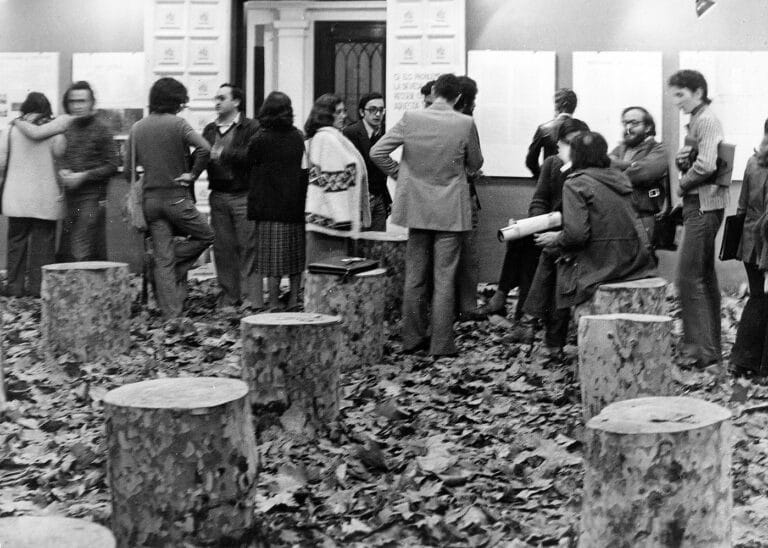
Its first exhibition was part of the campaign in favour of Human Rights that Justícia i Pau had launched. Or the installation Salvem la Devesa , which had the collaboration of the Environmental Group and the sponsorship of the Professional Associations of Girona, reflected a generalised citizen sentiment regarding the progressive degradation of the area.
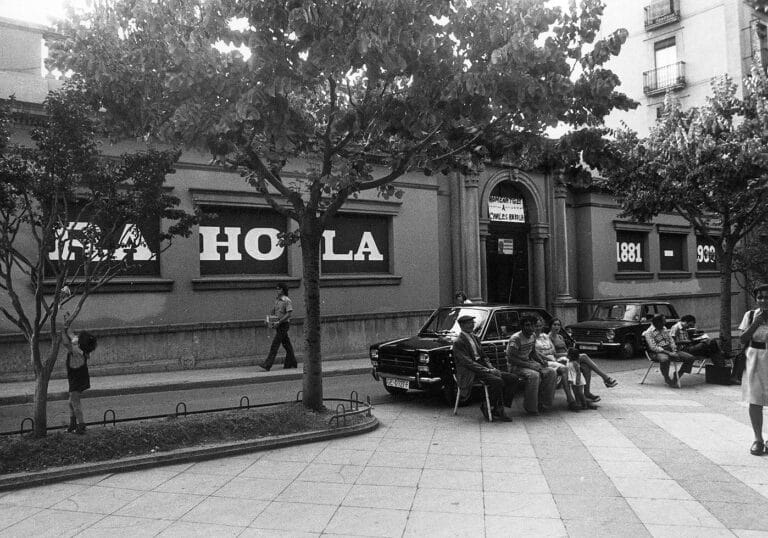
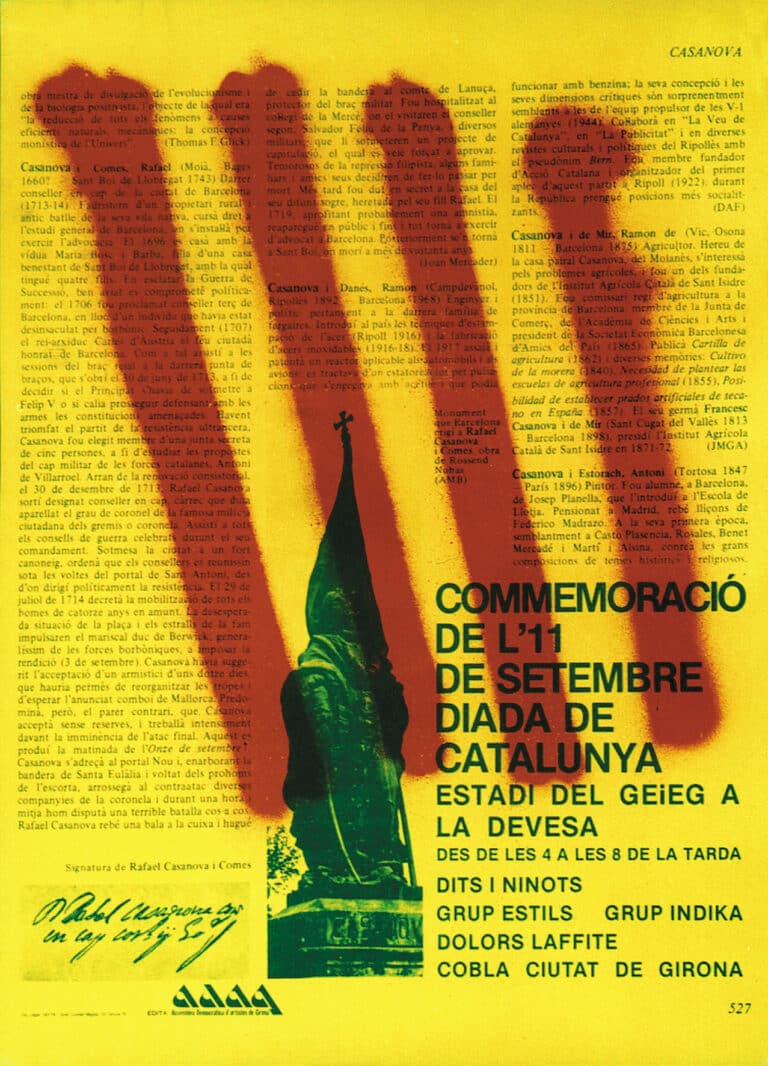
The Tribute to Carles Rahola , the prominent Girona man of Cadaqués origin who was shot by Franco in 1939, was the exhibition that had the greatest impact. The magazine Presència had dedicated a special issue to him and later the ADAG, with the support of the entire democratic opposition and numerous entities in Girona, mounted the exhibition. On September 11, 1977, the ADAG, apart from making the poster calling for the unitary demonstration of the National Day, carried out a performance in Plaça de Catalunya, which consisted of raising four large red bars in space and their subsequent deployment along the bed of the Onyar.
Its last participation was during the Sant Jordi’s Day of 1978, when the sculpture in tribute to Carles Rahola was inaugurated on the Rambla de la Llibertat, which had been promoted by the group of artists. The event included a speech by the future mayor Joaquim Nadal. Later, but already in a situation of internal dismemberment, the ADAG made some critical positions on various issues of the moment.